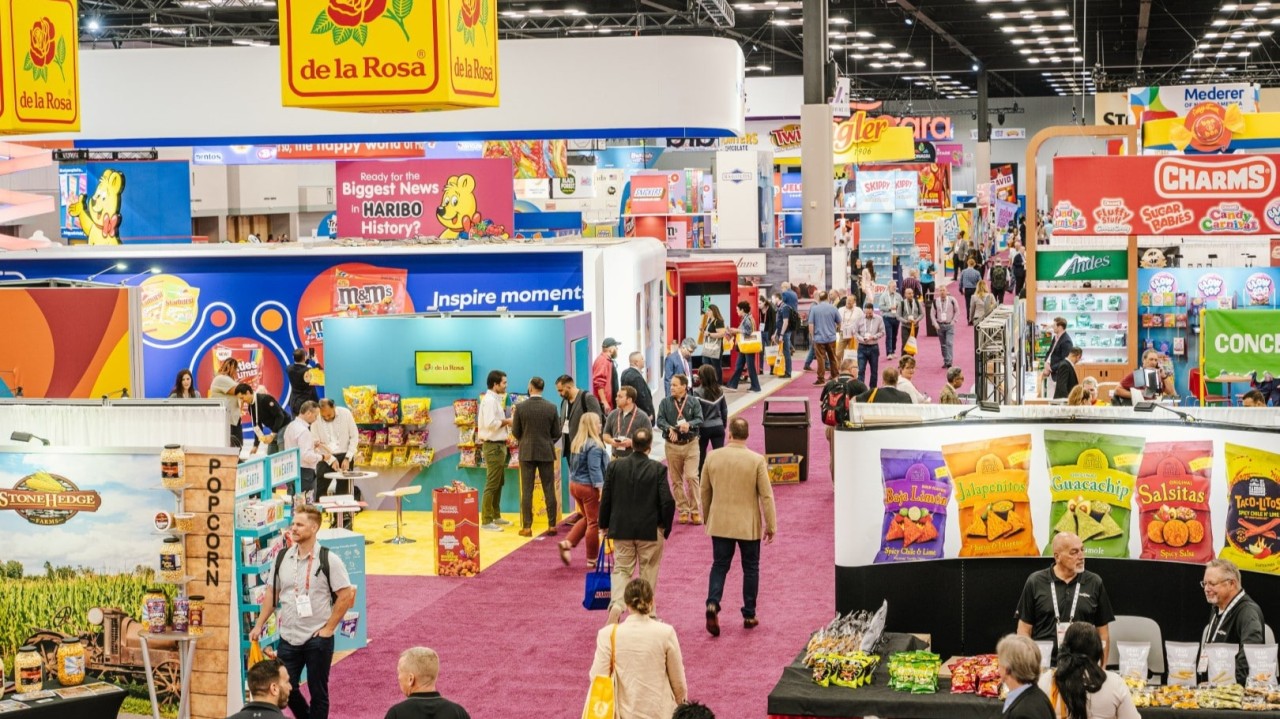
The Sweets & Snacks Expo is always full of new flavors, new packaging, new claims, and new brands trying to earn attention. But the real value of walking the floor is not only spotting what is trending, it’s understanding what those trends signal for the brands trying to grow at Target, Walmart, Amazon, Kroger, and other major retailers.
This year, the story was clear: snacks and sweets are moving into a more demanding phase of growth. Shoppers still want fun, indulgence, discovery, and flavor, but they are also bringing higher expectations around ingredients, functionality, format, and brand relevance. Retailers are watching those same shifts closely, because every new product has to do more than look interesting. It has to prove it can drive the category forward.
After walking the Expo floor, our Bluebird team saw several clear signals brands should be paying attention to as they build for retail growth.
Marketing innovation is becoming as important as product innovation
For Brendan Murphy, VP at Bluebird Group on the Target team, one of the biggest takeaways was that brands can no longer rely on product innovation alone to create momentum.
“Innovation in marketing is as important as product innovation,” Brendan said. “Whether it be an LTO collab or a celebrity partnership, you need to find ways to drive newness, excitement, and relevancy for your brand.”
This matters because the modern retail environment is crowded across every touchpoint. A product has to win on shelf, on the digital shelf, through retail media, in social content, and in the merchant conversation. Newness still matters, but the brands that cut through are often the ones that know how to create a reason for shoppers and retailers to care right now.
A limited-time offer, brand collaboration, licensed flavor, or celebrity partnership can create urgency and cultural relevance, but only if it connects back to a real shopper behavior or category opportunity. The strongest marketing ideas help explain why the product belongs in the shopper’s life and why the retailer should believe it can bring energy and growth to the assortment.
For emerging brands, this kind of marketing innovation can help create proof of demand and demonstrate that the brand knows how to activate beyond the shelf. For established brands, it can bring fresh attention to a familiar business without abandoning what already works.
The retail question is “What’s new?” and also, “What kind of newness can create category growth?”
Clean label is becoming the baseline expectation
Brendan also pointed to another major shift brands should not overlook: clean label is moving from a differentiator to a requirement.
“Clean label will be table stakes,” Brendan said. “It means different things in different categories, like no artificial colors in candy or no seed oils in bars or salty snacks, but we’re seeing merchants value this on behalf of their shopper, and they want to get their assortment there as fast as possible.”
That is a meaningful signal for brands across sweets, snacks, bars, and grocery. Clean label does not mean the same thing in every category, and it should not be treated as a generic claim. In candy, shoppers and retailers may be looking more closely at colors and additives. In salty snacks or bars, the conversation may move toward oils, ingredient familiarity, or perceived processing.
Ingredient expectations are changing and retailers are using those expectations to shape where the assortment goes next.
For brands, that means clean label cannot be handled as a last-minute packaging claim. It has to be part of product development, sourcing, pricing, retailer storytelling, and long-term category strategy. A clean label alone will not save a weak product, but a product that ignores where the shopper is heading may face more friction with both merchants and consumers.
Texture is becoming one of the strongest ways to create differentiation
While flavor is still central to sweets and snacks, texture stood out across the Expo as one of the more interesting forms of innovation. Brandy Hanger, VP Sales at Bluebird Group on the Kroger team, noticed a strong presence of multi-texture candy and snack offerings.
“There was a lot of multi-texture candy and snack offerings,” Brandy said. “A mash-up of flavors and textures, whether it was freeze-dried fruits with chocolate or Nerds coated or mixed in with chewy offerings.”
Think about how texture creates a more memorable eating experience. It gives brands another layer of differentiation in categories where flavor alone can be hard to own. Crunchy, chewy, creamy, sour, airy, freeze-dried, coated, filled, and layered formats all create more sensory interest, especially for younger consumers who are looking for products that feel more experiential and shareable.
Texture also helps brands create new usage occasions. A multi-texture candy may feel more like a treat, a social snack, or a discovery item. A freeze-dried fruit covered in chocolate may feel more permissible than a traditional confection. A chewy candy with a crunchy coating can bring a familiar flavor into a new format.
Asian-inspired flavors and real ingredients are gaining momentum
Brandy also called out two areas brands should be watching closely: “Asian flavors, like matcha strawberry and real ingredients.”
That combination says a lot about where consumer expectations are moving. Shoppers are becoming more open to global flavor influence, especially when it is paired with ingredients that feel recognizable, premium, or closer to the source. Matcha, fruit-forward fillings, sour profiles, and Asian-inspired flavor combinations are part of a broader shift toward more layered flavor experiences.
Functional snacking is expanding beyond protein
Protein has been one of the biggest forces in snacking for years, but Ryan Ashe , SVP/GM at Bluebird Group on the Kroger team, saw signs that the functional conversation is getting broader.
Ryan noticed “protein was even in fruit snacks,” along with “beef tallow as a key ingredient in nutrition bars,” “creatine in nutrition bars,” and “more Liquid I.V.-type offerings” with electrolyte drink mixers and refresher-style products.
Functionality is showing up in candy, bars, fruit snacks, beverages, drink mixes, and convenience formats. Consumers are looking for products that fit into their routines, whether that routine is fitness, hydration, energy, satiety, or everyday wellness.
This creates real opportunity, but brands need to be careful not to chase functional ingredients without a clear reason. Retailers and shoppers are getting better at spotting when a claim feels forced. Protein, creatine, electrolytes, fiber, and other functional benefits need to make sense within the product experience.
Digestive health may be the next major functional frontier
One of Ryan’s most important observations was around fiber and digestive health.
“Fiber as a key ingredient in protein bars,” Ryan said. “With GLP-1 and protein, digestive health is going to be playing a bigger role. I would look for food products to contain more digestive health benefits in the near and long term as more consumers will continue to be on GLP-1s for a longer period of time.”
This is a big call out for grocery brands because GLP-1 medications are already influencing how many consumers think about food, portion size, satiety, protein, and nutrition. As that behavior continues, digestive health may become a bigger part of the snack and bar conversation.
For brands, this does not mean every product needs to become a health product. It does mean the category is being reshaped by consumers who may be eating differently, looking for more nutrient density, and paying closer attention to how products make them feel.
Fiber, digestive support, protein quality, and satiety cues may become more important in categories that historically competed mostly on taste, indulgence, or convenience. The brands that understand this shift early will be better positioned to develop products, claims, and retailer stories that feel relevant to where the shopper is going.
What brands should do next
The Sweets & Snacks Expo made it clear that the category is moving in several directions and not in one. Shoppers want indulgence and better ingredients. They want global flavor and familiar formats. They want functionality and enjoyment. They want discovery, but they still need a reason to buy again.
That complexity is exactly why brands need more than a good product. They need a retail strategy that connects product innovation, shopper behavior, merchant priorities, category dynamics, and channel execution.
For emerging brands, the challenge is proving that a product can move from interesting to scalable. For established brands, the challenge is staying close enough to changing consumer expectations while protecting the core business that built the brand in the first place.
At Bluebird Group, we help brands grow at Target, Walmart, Amazon, Kroger, and other major retailers by connecting category insight, retail execution, and commercial strategy. The brands that will win in sweets and snacks are not the ones chasing every trend from the Expo floor. They are the ones that know which trends matter, how those trends apply to their shopper, and how to turn that insight into stronger retail performance.